

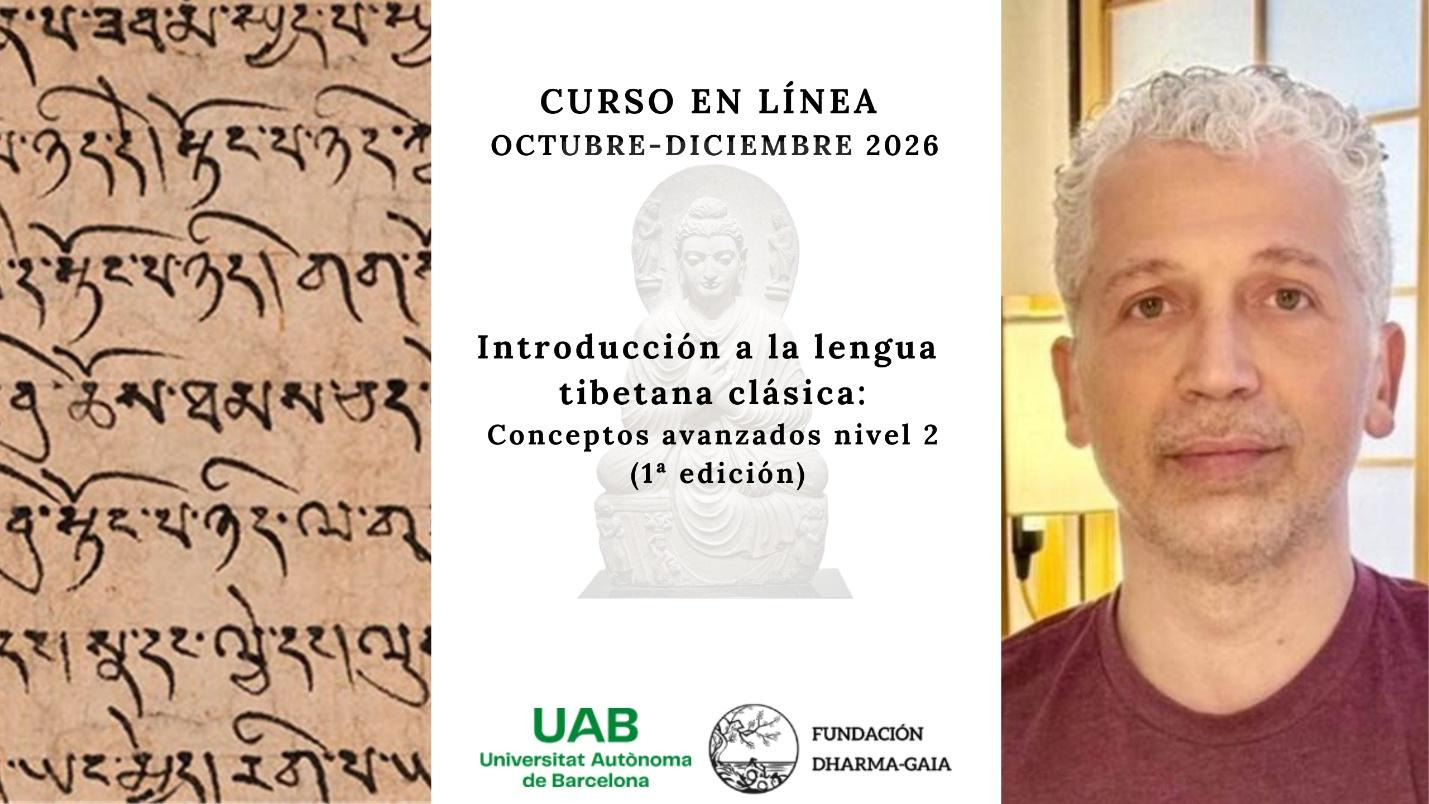
The Dharma-Gaia Foundation, in collaboration with the Autonomous University of Barcelona (UAB), announces the online course "Introduction to Classical Tibetan Language: Advanced Concepts (Level 2)." This course is aimed at students who wish to delve deeper into learning the classical Tibetan language and its relationship with Tibetan Buddhism, and is a natural continuation of the Level 1 course. It will be taught by Professor Ferrán Mestanza García, an expert in Tibetan language and culture with extensive experience in teaching it.
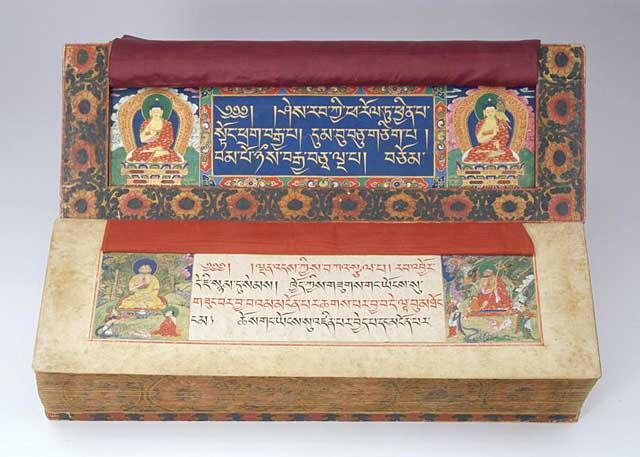
Tibetan Buddhism is one of Asia's most influential and rich cultural traditions. Originating in Tibet, it has expanded over the centuries, becoming a fundamental pillar of culture and spirituality in the region, from Tibet itself to areas such as Nepal, Bhutan, Mongolia, and parts of India, leaving a profound mark on various communities and cultures. Furthermore, in recent decades, Tibetan Buddhism has gained a significant presence in the West, where it has significantly influenced contemporary meditation, well-being, and spirituality practices.
This course will allow you to delve deeper into the richness of the Tibetan cultural tradition through the advanced study of its classical language, grammar, specialized vocabulary, and the translation of classical texts, combined with the analysis of fundamental philosophical and spiritual concepts of this tradition. The training not only develops advanced linguistic skills but also equips students with the analytical tools necessary to understand and work with more complex Tibetan texts. This makes it an ideal option for those seeking to specialize in Buddhist studies, translation of classical texts, or academic research on Tibet and its cultural legacy. UAB has been recognized as the best Spanish university in the QS World University Rankings 2024.
Course Description
The course "Introduction to Classical Tibetan Language: Advanced Concepts (Level 2)" offers a unique experience by combining the advanced study of grammar, specialized vocabulary, and the translation of classical texts, with the analysis of fundamental philosophical and spiritual concepts of Tibetan Buddhism.
The methodology, implemented through synchronous online classes, provides access to quality educational resources, specialized materials, and a didactic approach that fosters both theoretical and practical learning. UAB boasts excellent academic and technological infrastructure, including virtual platforms to facilitate online learning and interaction between students and professors. Additionally, active participation in research and analysis activities that enrich the educational experience is encouraged.
The sessions include practical exercises that delve into the linguistic, philosophical, and cultural aspects of classical Tibetan. Through this course, students will develop advanced skills that will enable them to understand and work with more complex Tibetan texts, interpret essential Buddhist concepts in original texts, and relate classical Tibetan terms to key concepts of Tibetan Buddhism to understand their philosophical dimension.
Practical Information
Language and Scope:
It is taught in Spanish and is aimed at students and the general public interested in the subject.
Duration:
It will have a duration of 25 teaching hours (4 ECTS credits), distributed over two weekly one-hour sessions via the virtual campus.
Dates and Schedule:
It will be held from September 22 to December 17, 2026, on Tuesdays and Fridays from 5:00 PM to 6:00 PM (Barcelona time, Spain), coinciding with morning hours in Latin America, which facilitates participation for students from that region.
Teams and UAB Virtual Campus:
Classes will be held virtually on the TEAMS platform, and on the Virtual Campus, students will have access to study materials, resources, and information on related activities.
Enrollment:
A maximum of 30 places are offered, to be filled in strict order of registration.
The tuition fee is €120.
Registration dates are from April 23 to September 17, 2026.
Admission requirement:
To be admitted, applicants must have completed secondary education and Level 1 of this course series. Alternatively, admission may be granted to those with prior knowledge of the language.

Certifications:
Upon successful completion of the course, participants will receive a certificate of achievement, endorsed by the Universitat Autònoma de Barcelona, which can be a valuable addition to their academic and professional CV. The cost of this certificate is not included in the tuition fee.
Academic direction:
Gustavo Pita Céspedes
Daniel Millet Gil
About the instructor:
Ferrán Mestanza i García holds a Diploma of Advanced Studies (DEA) in Advanced Asian Studies from the Sorbonne University. His academic background also includes a Bachelor's Degree in Foreign Languages, Literatures, and Civilizations, specializing in Tibetan Language, from Paris III University, and a Bachelor's Degree in Humanities, specializing in Philosophy, from Universitat Pompeu Fabra (Barcelona). His extensive education, combined with his experience as a classical Tibetan language instructor since 2008, ensures students receive expert and engaging guidance throughout the course to achieve a deep understanding of the language and its cultural context.
Course syllabus
- Contextualization of classical Tibetan.
- Tibetan vocabulary and concepts.
- Tibetan writing and grammar.
- Introduction and initial analysis of Buddhist literature in Tibetan.
- Reading and commentary of texts.
Career Opportunities
Students who complete the classical Tibetan training will be able to dedicate themselves to teaching and academic research in Asian studies, as well as to the translation and interpretation of Buddhist texts. They will also have the opportunity to offer cultural consultancy to Asia-related organizations and collaborate with museums and archives in managing collections of Asian art and literature. Furthermore, they can work in cultural management, promoting Tibetan culture through events and exhibitions. Finally, journalism and communication will allow them to write articles and reports on Tibetan language and culture.
Registration
Find the registration form link here (available on the UAB website):
Responsible Centers:
Faculty of Translation and Interpreting
Dharma-Gaia Foundation
Information and Contact Person:
For more information, please visit the course website or contact the designated person.
Contact: Gustavo Pita Céspedes
Email: gustavo.pita@uab.cat
Phone: +34 93 586 8901
Registration Contact: secretaria@fundaciondharmagaia.com
Additional information
UAB Specialization Course
Study code: 5337/1
1st edition
Credits: 4 ECTS
We invite all interested individuals to register and take advantage of this opportunity to expand their knowledge and deepen their understanding of classical Tibetan. Whether you are a student of Asian studies, a practitioner of Tibetan Buddhism, or simply someone with a profound interest in ancient languages and cultures, this course will offer you a unique and valuable educational experience.
Seize this unique opportunity to learn from an expert and delve into the fascinating world of classical Tibetan!
Useful links:
Faculty of Translation and Interpreting of the Autonomous University of Barcelona
School of Continuing Education
Articles published in Buddhistdoor in Spanish
Registration open: online course "Mahāyāna Buddhism and its expansion in East Asia" — 3rd edition
Ferran Mestanza: teaching the essence of Buddhism in the modern world
Buddhist Art Course: Beyond the Image. The Visual Legacy of Enlightenment
Key Publications in Spanish-Speaking Buddhist Studies
Buddhist Studies in Latin America and Spain (Volume I), edited by Daniel Millet Gil and Jaume Vallverdú. This first volume brings together a series of essays that explore the relationship between Buddhism and Hispanic American culture, addressing topics such as the reception of Buddhism in Latin America and Spain, translations of Buddhist texts into Spanish, and the impact of Buddhism on contemporary societies.
Downloadable at:
https://llibres.urv.cat/index.php/purv/catalog/view/563/583/1270
Buddhist Studies in Latin America and Spain (Volume II), edited by Daniel Millet Gil and Jaume Vallverdú. The second volume expands on the first, including contributions that analyze Buddhism from interdisciplinary and regional perspectives, with an emphasis on its interaction with local cultural traditions and its impact on the academic sphere.
Downloadable at:
https://llibres.urv.cat/index.php/purv/catalog/view/595/610/1301


